Sunday, July 13, 2014

Wizard of Oz. 2013.

I prefer pre-1980 pinball machines. I'm a big fan of EM and early solid state games. I enjoy newer games enough, but they seem too busy. The playfields are too complicated. With my preference for older games, I wasn't too interested in playing Jersey Jack's Wizard of Oz machine. It seemed to take what I dislike about modern games and amp it up.
Just take a look at the playfield:
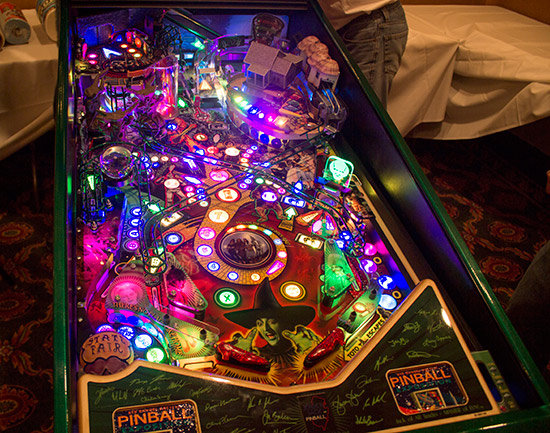
The multicolored lights covering every inch of the playfield look neat, but there is just so much going on, so much to do. The first year this machine was at Pinball at the Zoo you couldn't play it without waiting in line. This last year I was working at Pinball at the Zoo, so I was there almost all day everyday. I eventually found time to try this pinball out during a break. No one was in line, and curiosity was getting the better of me.
Well, I loved it! This is a really good pinball. I was surprised at how fun it was, despite being so busy. It is really easy to play, and a lot of fun. One of my favorite features was the scoring. Many pins, most pins, seem to make getting scores in the millions the norm, but all the really do is add a lot of zeroes to the end of your score. This game cuts all that out, making five digits a good score. A six digit score is a real achievement on this game.
The scoring system gives it a real old school feel, which helps draw you in. The game plays super smooth, too. It helps that the games are brand new, and don't have years of wear and tear on them. I would love to see one of these ten or twenty years in.
Aurcade.com currently lists fifteen of these spread across the country. This game is worth seeking out. Every serious pinball player should try this at least once. Even if you don't think you'll like it, you might be surprised.
This is the the first machine from Jersey Jack Pinball, and it marks the end of the recent dark period of pinballs. For quite a while Stern was the only company left making pinball machines. This is the first normal commercial pinball machine not made by Stern since 1999. Jersey Jack is now well on their way to release their second pinball, this time based on the Hobbit.


Saturday, May 3, 2014

Star Wars. Atari 1983.

I grew up in a world full of arcades. Every mall had an arcade, every town had an arcade. There was at least one game in the front of every store. While a lot of people both then and now collect the games, to me it always seemed like an unattainable dream.
This all changed around 1990 when my parents answered an ad in the paper for a stand up Star Wars. Star Wars was the first movie I saw in the theater, I collected the toys, I read the books and comic books, I went to conventions, and I was a huge fan of the game.
My parents paid 50 bucks for the game, a great price then or now, and it was in perfect condition. My dad and his friend, who was a pinball collector, moved the game to our house and somehow broke it in transport and we had to drop another $300 on it to have it fixed. Years later, when I moved into my first apartment the game was moved to my friends basement, where it eventually fell into disrepair.


This game uses color vector graphics. Vector graphics basically means everything on the screen is composed of lines. Other vector games include Asteroids and Tempest. Star Wars was available both in a standard upright cabinet and larger sit-down cockpit version. The game also features a unique controller, a two handed control yoke with four buttons.
Gameplay consists of three levels that repeat with increasing difficulty. All three levels reenact the finally of Star Wars: A New Hope., specifically, the assault on the Death Star also known as the Battle of Yavin. Level one is the approach to the Death Star. On this level you are shooting at TIE fighters, Darth Vader's TIE fighter, and the laser blasts they shoot at you. Basically an endurance level, you eventually move on to level two, the surface of the Death Star. This level has towers to shoot for points, guns on the surface, and as always, laser blasts to shoot or avoid.
Finally you get to the famous trench run. Here you avoid beams that run along the width of the trench, shoot at targets on the side of the walls, and of course shoot/dodge laser blasts. This level offers a bonus for "using the force". You do this by not firing your lasers until you get to the exhaust port.
This game had one direct sequel, based on Empire Strikes Back. The ESB version of this vector classic is much harder to find.

Thursday, April 10, 2014

Playball. Gottlieb 1971.

Playball is a single player electro-mechanical baseball themed pin from 1971. Sports themed games are generally not that interesting to me, but I really like this one. I also tend to dislike pins without plungers, and this game is an early example of that, but it works. Rather than pull back a plunger at the side of the playfield, the ball is shot from the center at the push of a button.
What makes this game interesting to me is that besides keeping score, you also score runs. I really get into this for some reason and find myself tracking only my runs and not my score. Plenty of targets are labeled "single", "double", "triple" and "home-run". These targets advance you through the bases and score runs. Free games start at 19 runs, and that is a realistic goal with a little practice.
There is an alternate version of this game from the same year called "Home Run". This version replaced free games with extra balls.

Playball at the IPMD

Find a Playball machine near you


Gameplay video: